
Zoonotic diseases
Written by Brian Jones, retired immunologist.
CLIMATE CHANGE AND THE INFECTIOUS DISEASE CRISIS
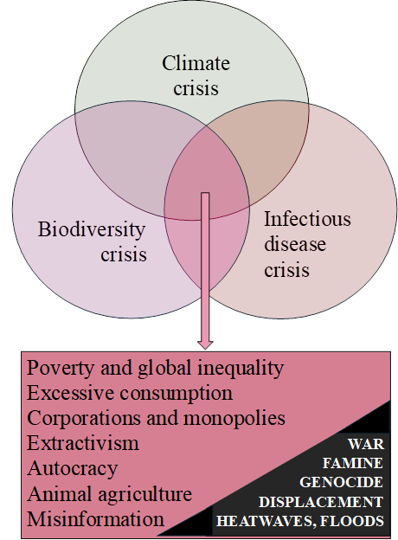
Humanity and the rest of Earth’s occupants are under extreme existential danger because of the changing climate. Anthropogenic greenhouse gases produced from extracting and burning carboniferous fossil fuels have reduced the ability of natural processes to cool the Earth and resulted in interlinked crises: extremes of unbearable climate change, the destruction of nature and the appearance of novel infectious pathogens. The deterioration of natural systems threatens energy, food, and water security, and increases the risk of disease, disaster, displacement and conflict. The consequences are already being felt across the World.
INFECTIOUS DISEASES
Among the most important health impacts are those resulting from infectious diseases. These include novel emerging infectious diseases, foodborne and waterborne diseases and antimicrobial resistance.
Epidemics emerge when a microbe is introduced into a new, non-immune, host population where it becomes established and spreads.
Around 60% of novel emerging human infections are zoonotic in nature, i.e. they are spread from a primary host to a different species. More than 70% of zoonoses originated from wildlife species.
The 13 most common zoonoses cause an estimated 2.4 billion cases of illness and 2.7 million deaths in humans per year. They are most impactful in lower-income countries.
TYPES AND EXAMPLES OF ZOONOTIC DISEASE
· Bacterial - Anthrax, Salmonellosis, Lyme disease, Brucellosis, Plague
· Viral - Rabies, AIDS, Ebola, Nipah, Lassa, Zika, Influenza, SARS, Covid, M-pox
· Protozoal - Giardiasis, Cryptosporidiosis, Toxoplasmosis
· Parasitic - Trichinellosis, Trematodiasis, Echinococcosis
· Fungal - Ring worm, Aspergillosis, Cryptococcosis, Histoplasmosis
· Rickettsial - Q-fever
· Chlamydial - Psittacosis
· Mycoplasmic - Pneumonia
· Acellular agents (prions) - Spongiform encephalopathies such as Creutzfeldt-Jakob disease.
CAUSES OF ZOONOTIC DISEASES
· Wild and domesticated animals and birds may carry pathogens and transmit them to other species.
· Once the pathogen is released, it must survive and disseminate until it meets the secondary host.
· For widespread dissemination the pathogen must either become airborne and infect by the oral or respiratory routes, or be transmissible through damaged skin or during sexual intercourse.
· Direct transmission to humans can happen through exposure to an infected wild, farmed or domesticated animal, or through hunting, butchering, and trading of infected animals.
· Indirect transmission occurs when an intermediate host, such as a biting insect, is infected from the original host animal and then transfers it to humans by bites or stings.
· Many zoonoses have an earlier translocation out of bats, whose natural habitats are particularly vulnerable to destruction by agriculture and forestry.
RECENT EPIDEMICS
Recently emerged epidemic or pandemic zoonotic infections include:
· Acquired immunodeficiency syndrome (AIDS) due to human immunodeficiency virus (HIV), spread initially from chimpanzees and subsequently by sexual intercourse.
· Swine flu due to H1N1 flu virus from pigs.
· Middle-East respiratory syndrome (MERS) due to a Coronavirus from camels.
· Nipah, due to a Henipavirus from fruit bats.
· Lassa, due to an Arenavirus from rodents.
· Zika, due to a Flavivirus from Rhesus macaque monkeys.
· Ebola, due to Orthoebolavirus from primates.
· Pulmonary or renal syndrome caused by an Orthohantavirus from infected rodents.
· Severe Acute Respiratory Syndrome (SARS), due to a Coronavirus (SARS-CoV-1) from Civets.
· Covid-19, due to a Coronavirus (SARS-CoV-2) probably from Pangolins.
· M-pox, due to an Orthopoxvirus from rodents.
· Avian flu, due to H5N1 flu virus, is currently affecting many species of wild birds and poultry, and though few humans have so far become infected, the possibility exists that viral mutations could lead to a strain of avian flu virus that could infect humans.
There have been impressive recent advances in disease screening, vaccine development and treatments of infectious diseases. However, these interventions are often less available to poorer nations.
FLOODS AND MELTING ICE
Floods from increased rainfall expose populations to pathogens in sewerage and washed from farmland, causing diseases such as cholera, dysentery, hepatitis, typhoid, malaria, dengue, leptospirosis, respiratory infections and skin infections.
Rising temperatures melt ice, glaciers and permafrost, releasing ancient pathogens from exposed diseased carcasses, which current populations have no immunity against. Key infections linked to this phenomenon include anthrax, leptospirosis, toxoplasmosis, tularaemia, brucellosis, and rabies.
Warmer oceans and rivers favour survival of water-borne pathogens and higher temperatures increases the geographical range of vector insects like mosquitoes and ticks, exposing more populations to infection.
CHANGING LAND USE
Deforestation and conversion of land to human-dominated systems drive loss of biodiversity and expose adjacent human communities to novel microbes, which may become widely disseminated in non-immune populations.
Excessive agricultural use of antibiotics gives rise to antibiotic-resistant bacteria. Over-reliance on pesticides and fertilizers poison the land. Run-off of agricultural chemicals pollutes waterways and kills off flora and fauna.
As climate and land use change, animals carrying pathogens migrate to new areas. Ranges of disease vectors like mosquitoes and ticks increase as the planet warms, and they can spread to new, previously unexposed, populations.
Intensive agricultural animal management (factory farming) confines large numbers of animals and their copious wastes in cramped conditions, perfect conditions for zoonotic disease emergence and dispersion.
Aquaculture is increasingly replacing marine capture as a source of human food and animal feed. Farmed aquatic species can become infected with pathogens not found in the wild. Consumption of aquaculture products increases the possibility of contracting zoonotic infections from either handling or ingesting improperly cooked or raw fish or fish products.
COST
The financial costs of three recent pandemics - SARS, Swine flu and Ebola - were nearly $150 billion. The global economy contracted by 4.3% in 2020 due to COVID-19, amounting to about $3.6 trillion worth of goods, services and other output lost. COVID-19 reduced global Gross Domestic Product by an estimated $22 trillion and imposed annual healthcare costs of $2–3 trillion. In addition to causing high mortality and morbidity, zoonotic events disrupt trade, depress rural livelihoods, and inflict agricultural losses exceeding $100 billion per outbreak, with impacts disproportionately borne by low- and middle-income countries
EFFECT OF STRESS
Physical and psychological stress reduce immunological capability to control infections. The increasing likelihood of high temperatures, floods, droughts, wildfires, famine, poverty, etc. are extremely stressful and therefore make us less able to ward off infections. One well known intervention to lower stress is to take gentle exercise in natural green spaces, so the preservation of wild nature is both a benefit to health and an economic benefit in reducing healthcare spending on stress-related illnesses.
Intensive cattle and poultry farming are exceptionally stressful, so stock are more susceptible to infectious pathogens than free-range animals. Furthermore, immunological screening tests for infectious cattle diseases such as bovine tuberculosis can be false negative due to stress-induced immune suppression.
ONE HEALTH
The One Health Joint Plan of Action is designed to create sustainable and holistic solutions to better manage threats to the health of humans, animals, plants, and the environment and prevent potential future pandemics. It recognizes that the health of humans, domestic and wild animals, plants, and the wider environment (including ecosystems) are closely linked and interdependent. It is primarily supported by the World Health Organization (WHO), the World Organization for Animal Health (WOAH), the Food and Agriculture Organization (FAO), and the United Nations Environment Programme (UNEP).
CONCLUSIONS - THE ALTERNATIVES
Zoonotic diseases are clearly linked to the climate and biodiversity crises and it will not be possible to prevent further epidemics or pandemics without tackling all three crises in concert. Achieving this will require governments throughout the world to understand the threat infectious diseases pose to the very survival of humans and other species of animals and plants.
Governments should be working towards sustainable alternatives to oil and gas energy supplies, food production, farming and land use. They should be working to equalise living standards in all parts of the world, they should be preparing to accommodate displaced populations, and they should be ceasing production of the means to perpetrate violence, oppression and war.
RECOMMENDED READING
Climate change – key facts
https://www.who.int/news-room/fact-sheets/detail/climate-change-and-health
Zoonotic diseases: etiology, impact, and control https://pmc.ncbi.nlm.nih.gov/articles/PMC7563794/
Zoonoses – key facts
https://www.who.int/news-room/fact-sheets/detail/zoonoses
Zoonotic diseases: classification, causes, prevention, control
https://microbenotes.com/zoonotic-diseases/
The global burden of neglected zoonotic diseases: current state of evidence https://www.sciencedirect.com/science/article/pii/S2352771423001155
Emerging zoonotic diseases - an insight
https://www.icliniq.com/articles/infectious-diseases/emerging-zoonotic-diseases
Annual summary of global infectious diseases in 2024
https://www.scienceopen.com/hosted-document?doi=10.15212/ZOONOSES-2024-1006
Identifying the climate sensitivity of infectious diseases: a conceptual framework
https://www.thelancet.com/journals/lanplh/article/PIIS2542-5196(25)00169-X/fulltext
Looking beyond land-use and land-cover change: zoonoses emerge in the agricultural matrix https://www.sciencedirect.com/science/article/pii/S2590332223003895#
Land use change and infectious disease emergence https://agupubs.onlinelibrary.wiley.com/doi/full/10.1029/2022RG000785
Links between industrial livestock production, disease including zoonoses and antimicrobial resistance https://onlinelibrary.wiley.com/doi/full/10.1002/aro2.19?msockid=25c9226275146c481eda375774256d32
Zoonotic diseases of fish and their prevention and control https://www.tandfonline.com/doi/pdf/10.1080/01652176.2022.2080298
The price of pandemics
https://www.worldfinance.com/strategy/the-price-of-pandemics
The COVID-19 pandemic and the $16 trillion virus https://pmc.ncbi.nlm.nih.gov/articles/PMC7604733/
Drivers and consequences of viral zoonoses: public health and economic perspectives https://www.mdpi.com/2813-0227/5/4/32
Climate change and mental health: direct, indirect, and intersectional effects
https://www.thelancet.com/journals/lanepe/article/PIIS2666-7762(24)00136-4/fulltext
Nature: how connecting with nature benefits our mental health
One Health Joint Plan of Action
Standing up for science in an age of political interference
https://www.bmj.com/content/388/bmj.r638
